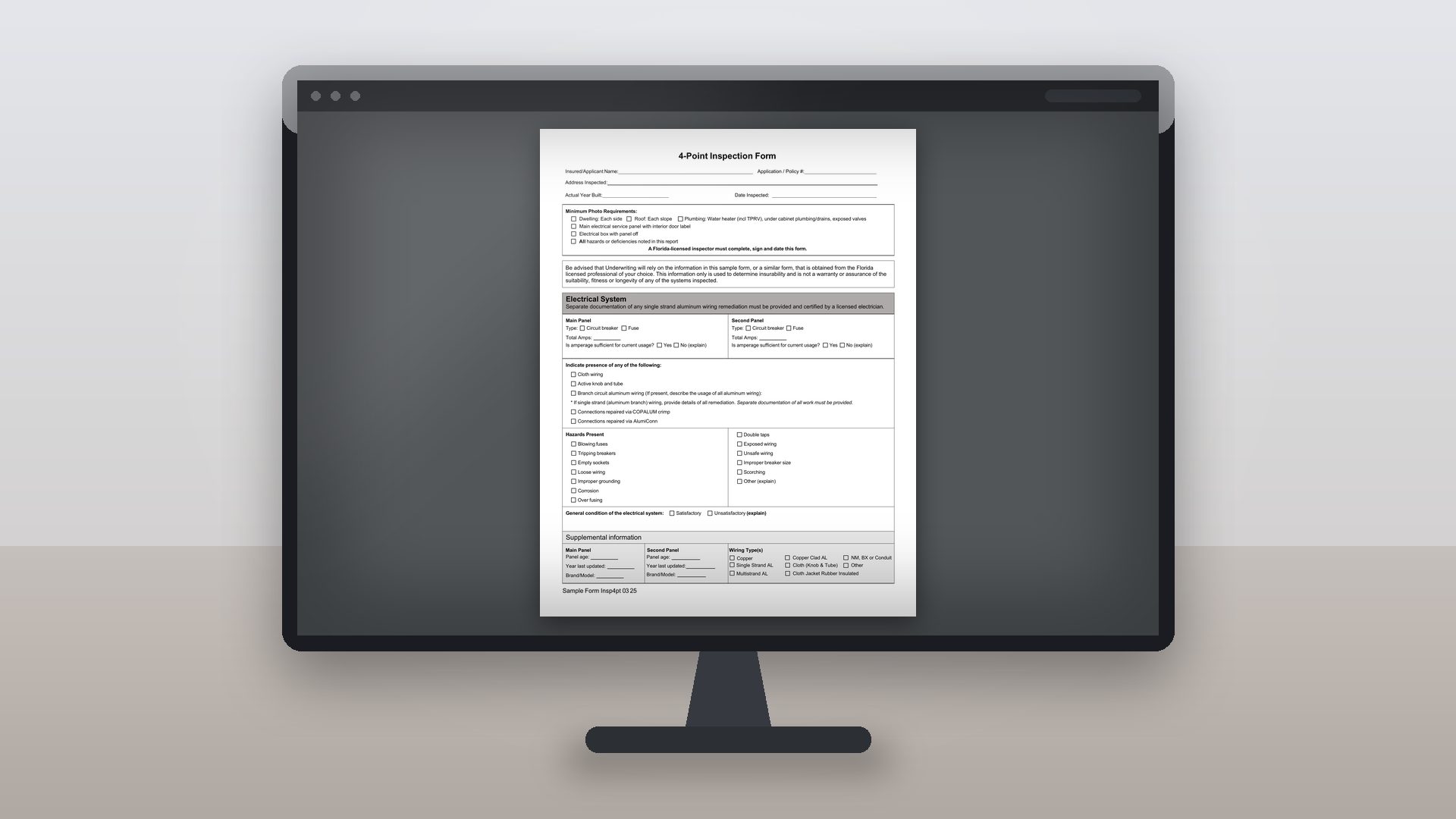

Completing the Florida 4-Point Inspection Form 2026
Master the Citizens Insp4pt (03/25) form line by line — the inspection form underwriters rely on to decide whether your client's older home can be insured. Four hours of general continuing education built entirely around real underwriting triggers: panel hazards, polybutylene supply lines, roof slope photography, and the detail that helps keep a form from bouncing back to your desk.
About This Course
This course takes one document — the Citizens 4-Point Inspection form in its March 2025 revision — and works through it section by section, the way an underwriter actually reads it. You'll learn how the header and photo requirements set up everything that follows, why photographing every roof slope (not every side) lets this form substitute for a separate roof inspection deliverable, and why a single skipped slope means redoing the work twice. The electrical modules walk the panel-interior photograph and the thirteen-item hazards checklist as a connected system: double taps, over-fusing, corrosion and scorching read from the panel-off (dead front removed) photo, exposed wiring and grounding issues read from the house, and what you tick directly constrains what you can honestly write in the condition call.
Plumbing gets the same treatment, with a dedicated look at polybutylene pipe — how to recognize it by color, fitting type and installation era, where to check for it (water heater connections, main shutoff, under-sink stub-outs), and why a partial copper repipe doesn't take a house off the list. HVAC hazards are handled as the four-question decision tree the form actually uses, with particular attention to the March 2025 revision and to why supplementary and improvised heat sources draw more scrutiny than cooling equipment ever does in Florida. The roof module separates roof age from remaining useful life, explains the documentation that becomes necessary as coverings approach the end of their expected service life, and covers the explanation now required when leak signs are present.
The closing modules cover the comments section, the certification block and who is authorized to sign, plus a module built entirely around why Citizens forms actually get rejected and sent back — turning Citizens' published form requirements into a checklist you can run before you ever submit.
This is not an introductory home inspection course. It assumes you already inspect homes and is built for inspectors who want to stop guessing at what an underwriter needs and start producing a form that clears the first time. You'll earn 4.0 CE hours of general continuing education toward your Florida license renewal.
What You'll Learn
- Identify when a 4-Point Inspection is required and what the header and photograph requirements obligate you to capture on-site
- Apply the photograph-every-slope standard to allow the roof section to substitute for a separate roof inspection deliverable
- Recognize the thirteen electrical hazard conditions and group them by cause — overload, connection failure, exposed wiring, and grounding/corrosion — to read a panel efficiently
- Explain how panel-interior photographs support the electrical condition call and hazard checkboxes
- Apply the four-question HVAC hazard decision tree, including when a yes answer requires photographic documentation
- Identify polybutylene supply piping by material, color and fitting type, and locate the three places it is most reliably found
- Differentiate roof age from remaining useful life and identify the documentation needed as a covering approaches the end of its expected service life
- Explain the certification requirements, including who may sign the form and what the comments section must contain
Who This Is For
Prerequisites
Curriculum
Introduces the Citizens Insp4pt form and how the four hours ahead map onto its sections, from header through certification.
Covers what distinguishes a 4-Point Inspection from a full home inspection and the circumstances that trigger the need for one.
Walks through the form's header fields and photograph requirements, and explains how underwriters actually use this documentation to make coverage decisions.
Teaches how to photograph and read an electrical panel interior, and what panel findings most directly influence insurability.
Breaks the thirteen electrical hazard checkboxes into four logical groups and shows how those findings drive the overall electrical condition call and detail entries.
Covers the HVAC section's age, equipment and hazard questions, including the four-item hazard decision tree and its March 2025 update.
Details plumbing material identification, water heater reporting, and leak documentation, with a focused walkthrough of polybutylene pipe recognition and reporting.
Explains slope-by-slope roof photography, the distinction between roof age and remaining useful life, and how to document visible leak signs correctly.
Covers what the comments section must include, the certification block, and who is authorized to sign the completed form.
Reviews Citizens' own submission rules and the recurring reasons forms are rejected or returned, so students can catch these issues before submitting.
Summarizes the form section by section and reinforces the reporting habits most likely to prevent a returned or rejected inspection.
Lessons are narrated by an AI-generated voice reading the instructor’s written script — not a human recording.